How Audit Firms Handle Busy Season With Offshore Back-Office Teams
How Audit Firms Handle Busy Season With Offshore Back-Office Teams
Busy season is coming. Again.
You already know the dates. For clients with a 31 December year-end:
- Saudi Arabia: zakat and corporate income tax returns are due within 120 days, so by 30 April (ZATCA).
- Qatar: the tax return is due within four months, also by 30 April (General Tax Authority).
- UAE: the corporate tax return is due within nine months, so by 30 September (Federal Tax Authority).
Where audited statements support those filings, the audit has to be signed first.
The deadlines don’t move. So every year, the same thing happens: the work piles up, senior people stay late, and review gets squeezed into the last few weeks.
The real question is:
How much of your busy season is spent on work that doesn’t need your senior team?
Start With One Question: What Actually Fills Busy Season?
Before hiring temporary staff or asking your team for more overtime, look at what fills the hours.
Take a few engagements from last season and list where the time went. You will probably find a lot of it here:
- Building lead schedules and tying out the trial balance
- Preparing working papers and supporting schedules
- Chasing clients for missing PBC documents
- Drafting and casting financial statements
- Organizing audit files
- Fixing the same review comments again and again
Very little of that needs a partner’s judgment.
All of it needs to be done.
That is exactly the gap an offshore back-office team is built to fill.
1. Plan Capacity Before Year-End, Not in March
Busy season is the most predictable crisis in an audit firm.
Yet many firms only look for extra hands when the pressure has already arrived.
By then, it is too late to set things up properly.
Instead, map your calendar early:
- Which clients have the same filing deadline?
- Which engagements are the largest?
- When must each file be ready for review?
Once you can see the peak, you can plan how much support you need, and when.
2. Decide What Stays With the Firm and What Can Move
Not every audit task needs the same level of expertise.
Stays with the firm: planning, risk assessment, key judgments, client communication, review and the signed opinion.
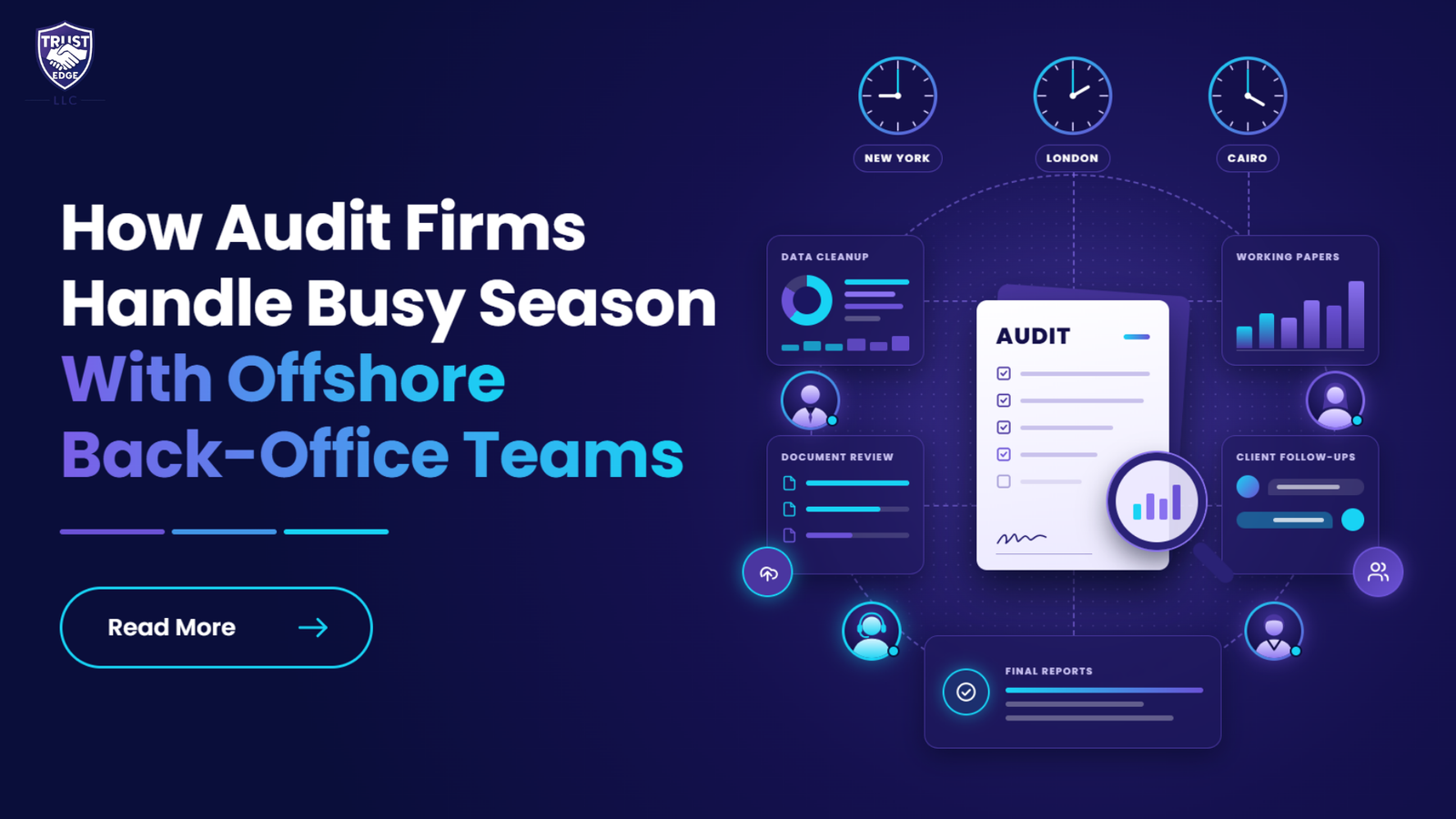
Can move to a back-office team: working paper preparation, supporting schedules, audit file organization, financial statement drafting and document follow-ups.
This does not hand over responsibility.
It makes sure your most experienced people spend busy season on the work only they can do.
3. Keep the Offshore Team Inside Your Quality System
More hands only help if quality holds.
The IAASB’s quality management standards, effective since 15 December 2022, were updated to address the use of external service providers (IAASB). ISA 220 (Revised) requires the engagement partner and team to be proactive in managing and achieving quality on each audit (IAASB).
In practice, that means:
- A written scope for every engagement
- Clear review steps before anything is relied on
- Controls over who can access client data
An offshore team is not a shortcut around your quality system.
It is part of it.
4. Use Your Templates, Not Theirs
If the back-office team uses its own formats, your reviewers lose time just understanding the file.
Share your working paper templates, referencing style and file structure from day one.
The goal is simple: a file prepared offshore should look exactly like a file prepared in your office.
5. Define “Ready for Review” Before the First File Moves
The slowest part of busy season is often the back-and-forth between preparer and reviewer.
Agree in advance what a finished file looks like. For example:
- Supporting documents are attached
- Schedules tie to the trial balance
- References are checked
- Open points are listed clearly
When everyone works to the same definition, reviewers can focus on the audit, not on missing pieces.
6. Start Small, Then Scale
You don’t need to hand over twenty engagements on day one.
Start with one or two.
Let both teams learn each other’s way of working while the pressure is still low.
Then scale up once the process is proven.
What Can an Offshore Back-Office Team Support?
Depending on the firm and the engagement, support may include:
- Working paper preparation
- Supporting schedules
- Bank and other reconciliations
- Audit file organization
- Financial statement preparation
- Document follow-ups
Your team stays focused on judgment, review and the client relationship.
More Overtime Is Not the Only Answer
When busy season hits, the usual response is longer hours.
But overtime has limits, and tired reviewers miss things.
Ask instead:
Can we plan earlier? Can we separate preparation from review? Can part of the preparation be supported remotely?
The answer may not be a longer day.
It may be a better-organized season.
The Bottom Line
You can’t move the filing deadlines.
But you can decide how ready your firm is when they arrive.
When you plan capacity early, keep judgment in-house and move routine preparation to the right resource, your team can deliver more engagements without burning out.
At TrustEdgeLLC, we provide remote audit and accounting back-office support for firms that need extra capacity in busy season, without expanding their internal team.
Follow TrustEdgeLLC for more practical insights on audit support, accounting operations and outsourcing.