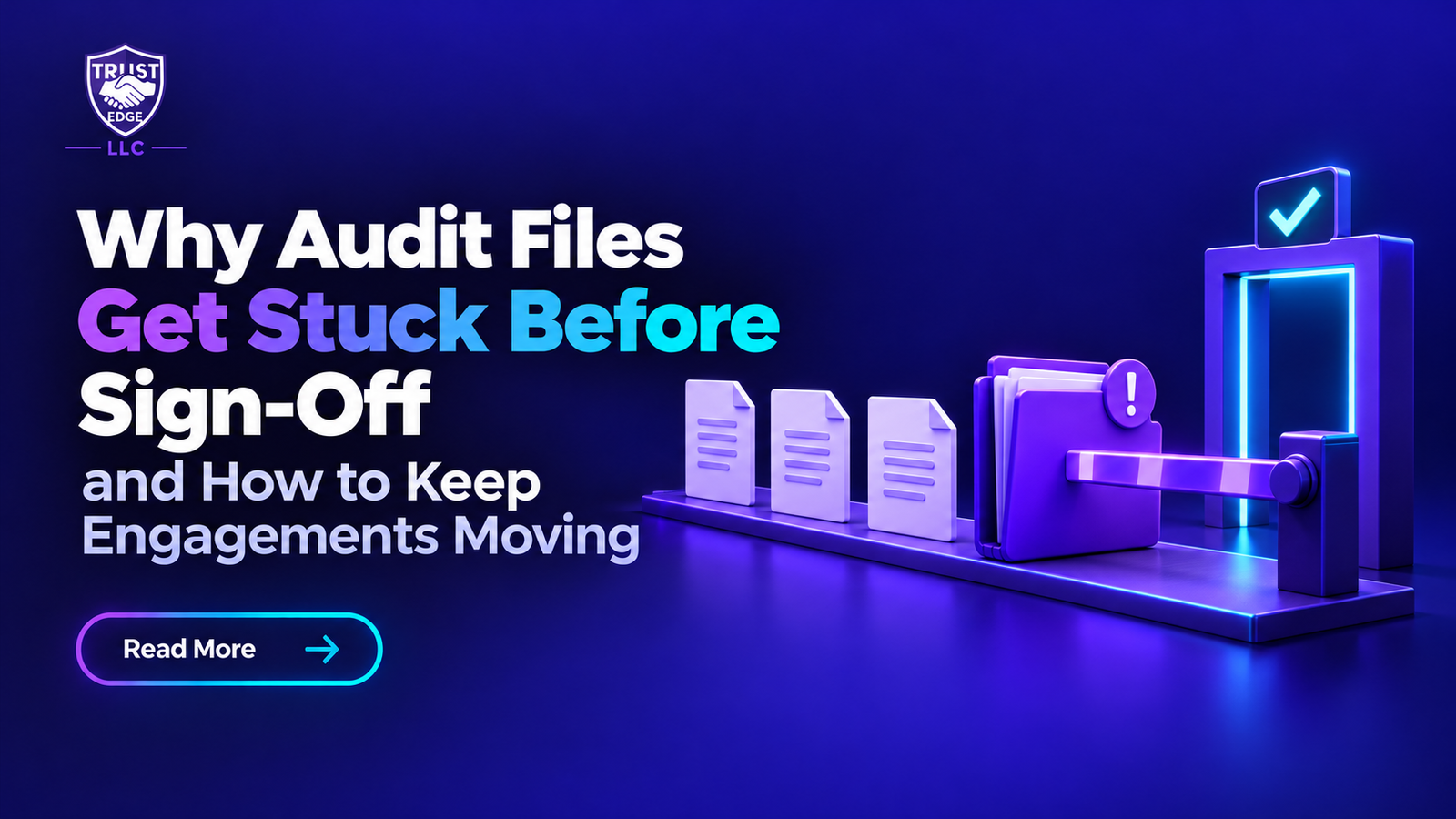
Why Audit Files Get Stuck Before Sign-Off and How to Keep Engagements Moving
Why Audit Files Get Stuck Before Sign-Off — and How to Keep Engagements Moving
The fieldwork is done.
The client is waiting.
The file is “almost ready.”
And it stays almost ready. For days. Sometimes for weeks.
Every audit firm has files like this. Nothing is badly wrong with them, but they never quite reach sign-off. Meanwhile, the next engagements are already queuing behind them.
The real question is:
What is actually holding the file back?
Where Do Audit Files Get Stuck?
Look at the last few engagements that ran late. The delay usually sits in one of these places:
- Client documents that arrive after fieldwork has finished
- Review points that nobody clearly owns
- Schedules that don’t tie to the trial balance
- Late adjustments that change numbers already reviewed
- Financial statements and disclosures drafted at the very end
- Files waiting in a queue for the partner’s time
Notice something?
Most of these are not technical problems.
They are flow problems. And flow problems can be fixed.
1. Give Every Review Point an Owner and a Date
A review point without an owner is a review point that stays open.
When comments sit in a list that “the team” is working on, nobody feels responsible for closing them.
For every open point, record three things:
- Who is fixing it
- What “closed” looks like
- When it will be done
One shared list per engagement is enough. The point is that anyone can see, at a glance, what still stands between the file and sign-off.
2. Don’t Let Late Client Documents Freeze the File
One missing bank confirmation or contract can hold up a whole section.
So track every PBC item through the same simple steps:
Requested → Received → Checked → Filed
Chase early and in one batch, not one email per item.
And while you wait, keep working on the sections that don’t depend on the missing item, instead of parking the whole file.
3. Tie Out Before You Hand Over
Nothing slows a reviewer down like a schedule that doesn’t agree to the trial balance.
The reviewer stops reviewing and starts investigating.
Before any file moves to review, the preparer should confirm that:
- Lead schedules agree to the trial balance
- Supporting schedules agree to the lead schedules
- Cross-references work
- Differences are explained, not left open
It takes minutes at preparation. It can take days at review.
4. Draft the Financial Statements Earlier
Many firms leave the financial statements and notes until fieldwork is finished.
That turns them into the last bottleneck before sign-off.
Instead, start a draft as soon as the trial balance is reasonably stable. Update it as the audit moves forward.
By the time fieldwork ends, you are reviewing a draft, not writing one from scratch.
5. Handle Late Adjustments Through One Updated Trial Balance
Late adjustments are normal. The problem is what happens after them.
If the change is not carried through every schedule, working paper and draft statement, the file ends up with numbers that no longer agree.
Keep one updated trial balance as the single source. When it changes, update everything linked to it, and note what changed and why.
6. Protect the Partner’s Review Time
In many firms, the final step is simply waiting for the partner.
That wait gets longer when files reach the partner incomplete and bounce back.
Two habits help:
- Book review slots in advance, especially in busy season
- Send only files that meet your “ready for review” standard
A partner’s time is the scarcest resource in the firm. Every file that arrives clean protects it.
7. Keep Documentation Up to Standard as You Go
Documentation left to the end is one of the quietest causes of delay.
ISA 230, the IAASB’s standard on audit documentation, sets what the file must show (IAASB). ISA 220 (Revised) also requires the engagement partner and team to be proactive in managing and achieving quality (IAASB).
Both are easier to meet when documentation is written while the work is done, not reconstructed after it.
What Can Be Supported Remotely?
Once you know where your files get stuck, you can separate the judgment from the preparation.
Depending on the firm and the engagement, a back-office team can support:
- Working paper preparation
- Supporting schedules and tie-outs
- Bank and other reconciliations
- Audit file organization
- Financial statement preparation
- Document follow-ups with clients
Your partners and managers keep the planning, the judgments, the review and the signature.
Pushing Harder Is Not the Fix
When files are late, the usual answer is to push: more emails, more evenings, more pressure on the same few people.
But a stuck file rarely needs more effort.
It needs a clearer path.
Owners for open points. Documents tracked. Schedules tied out. Drafts started early. Review time protected.
The Bottom Line
Audit files don’t get stuck because your team doesn’t know what to do.
They get stuck in the gaps between steps.
Close those gaps, and audit sign-off delays become the exception, even when the season is full.
At TrustEdgeLLC, we provide remote audit and accounting back-office support for firms that want their engagements to move faster, without expanding their internal team.
Have files stuck before sign-off right now? Tell us which sections keep slowing your team down, and we’ll show you what we can prepare.
Follow TrustEdgeLLC for more practical insights on audit support, accounting operations and outsourcing.