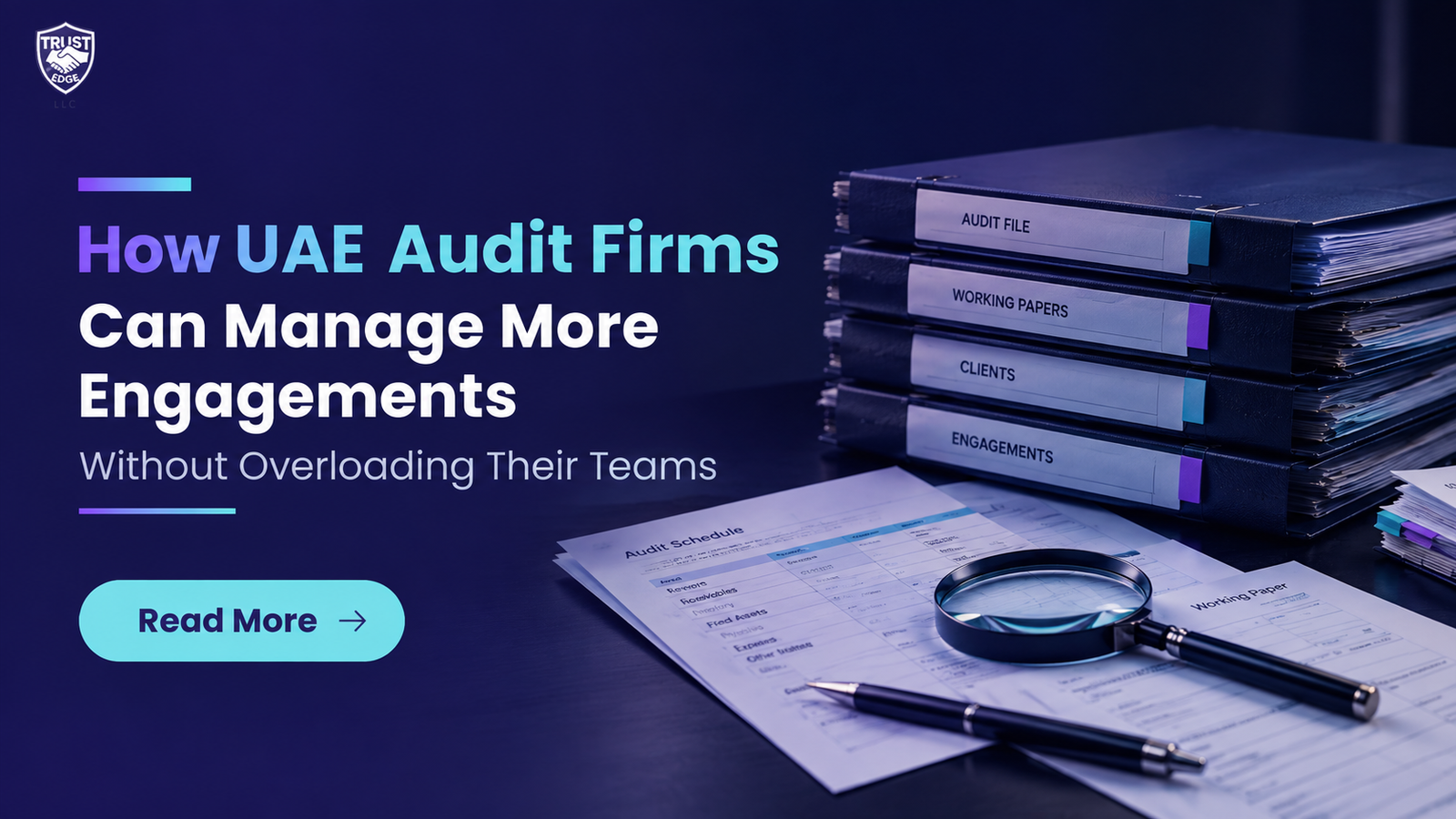
How UAE Audit Firms Can Manage More Engagements Without Overloading Their Teams
How UAE Audit Firms Can Manage More Engagements Without Overloading Their Teams
For UAE audit firms, growing the client portfolio also means managing more audit engagements, working papers, client requests, review points, and deadlines.
The challenge is not simply having more work. It is making sure senior auditors have enough time for planning, supervision, review, professional judgment, and client communication.
A dedicated remote audit support team can help by handling defined, repeatable parts of the audit workflow under the firm’s methodology, supervision, and review process.
Where Audit Teams Lose Time
Across multiple engagements, experienced auditors can spend significant time on work such as:
- Organizing audit documentation
- Following up on outstanding client information
- Preparing lead and supporting schedules
- Performing defined audit procedures
- Preparing working papers
- Supporting financial statement preparation
- Updating files after review comments
- Completing audit documentation
These tasks are necessary, but not all require the same level of professional judgment.
The opportunity is to separate execution work from work that requires senior audit expertise.
What Can Remote Audit Support Handle?
A remote audit support team can assist with defined engagement activities while the audit firm’s professionals retain responsibility for supervision, review, professional judgment, and final conclusions.
1. Client Requests and Audit Documentation
Support can include:
- Following up on outstanding documents
- Organizing client information
- Maintaining engagement trackers
- Organizing audit evidence
- Updating audit files
This gives the engagement team a clearer view of outstanding items and helps prevent administrative follow-ups from consuming senior auditors’ time.
2. Audit Working Papers and Schedules
Depending on the firm’s methodology, support teams can assist with:
- Lead schedules
- Account reconciliations
- Supporting schedules
- Audit documentation
- Working papers
- Financial statement tie-outs
The firm’s audit team can then review the prepared work and address items requiring professional judgment.
3. Defined Audit Procedures
Where appropriate and properly supervised, trained support staff can assist with defined procedures such as:
- Transaction testing
- Vouching and tracing
- Reconciliation work
- Revenue and expense testing support
- Accounts receivable and payable schedules
- Fixed asset schedules
- Inventory documentation
The procedures delegated should always be determined by the firm’s methodology, engagement circumstances, and professional requirements.
Keep Professional Judgment With the Audit Team
Remote audit support works best when responsibilities are clearly divided.
Remote Audit Support
Documentation → Schedules → Defined procedures → Working papers → File completion support
UAE Audit Team
Audit strategy → Risk assessment → Professional judgment → Supervision → Review → Conclusions → Client communication
The purpose is not to move the audit engagement away from the UAE firm.
It is to give the firm’s professionals more execution capacity without giving up control of the engagement.
Standardize the Process, Not the Client
Managing multiple audit engagements becomes difficult when every file follows a completely different internal process.
A standardized workflow can make repeatable work easier to manage:
Engagement Setup → Document Collection → Audit Procedures → Working Papers → Review → Clearance → Completion
The firm can define:
- Standard templates
- Documentation requirements
- Task ownership
- Review checkpoints
- Escalation procedures
- Completion requirements
Client-specific risks and professional judgments remain engagement-specific.
What Should Be Delegated?
A useful way to assess an audit firm’s workload is to divide tasks into three groups.
Repeatable Execution
Often suitable for structured support:
Documentation, schedules, reconciliations, defined testing, and working papers.
Professional Judgment
Requires appropriately qualified audit professionals:
Risk assessment, materiality, significant accounting judgments, evaluation of audit evidence, and audit conclusions.
Engagement Leadership
Remains with the firm’s responsible team:
Client management, supervision, review, significant matters, and the audit opinion.
This allows an audit firm to delegate defined processes without treating professional responsibility as an outsourcing task.
Quality and Confidentiality Still Matter
Increasing audit capacity should not come at the expense of quality or information security.
A remote audit support model should have:
- Clear access controls
- Defined responsibilities
- Documented procedures
- Review checkpoints
- Secure document handling
- Clear escalation routes
This is particularly important in the UAE, where the legal framework governing auditing and accounting includes requirements relating to professional practice and confidentiality.
Managing Peak Audit Workloads
Audit workload is not evenly distributed throughout the year.
During busy periods, firms may have several engagements moving through fieldwork, review, and completion at the same time.
A dedicated audit support team can provide additional execution capacity for defined tasks, allowing senior auditors to concentrate on:
- Engagement management
- Complex audit areas
- Review
- Significant findings
- Client communication
- Finalization
This gives the firm additional capacity without making every increase in workload dependent on adding senior-level resources.
The Bottom Line
Scaling an audit firm is not simply about adding more people.
It is about using the right level of expertise for the right part of the engagement.
With a structured remote audit support model, UAE audit firms can delegate defined execution work while keeping planning, supervision, professional judgment, review, and client leadership with their core audit team.
TrustEdgeLLC provides dedicated remote audit support for audit firms across the UAE and GCC, supporting audit documentation, working papers, defined audit procedures, financial statement preparation, and audit file completion as an extension of the firm’s existing team.