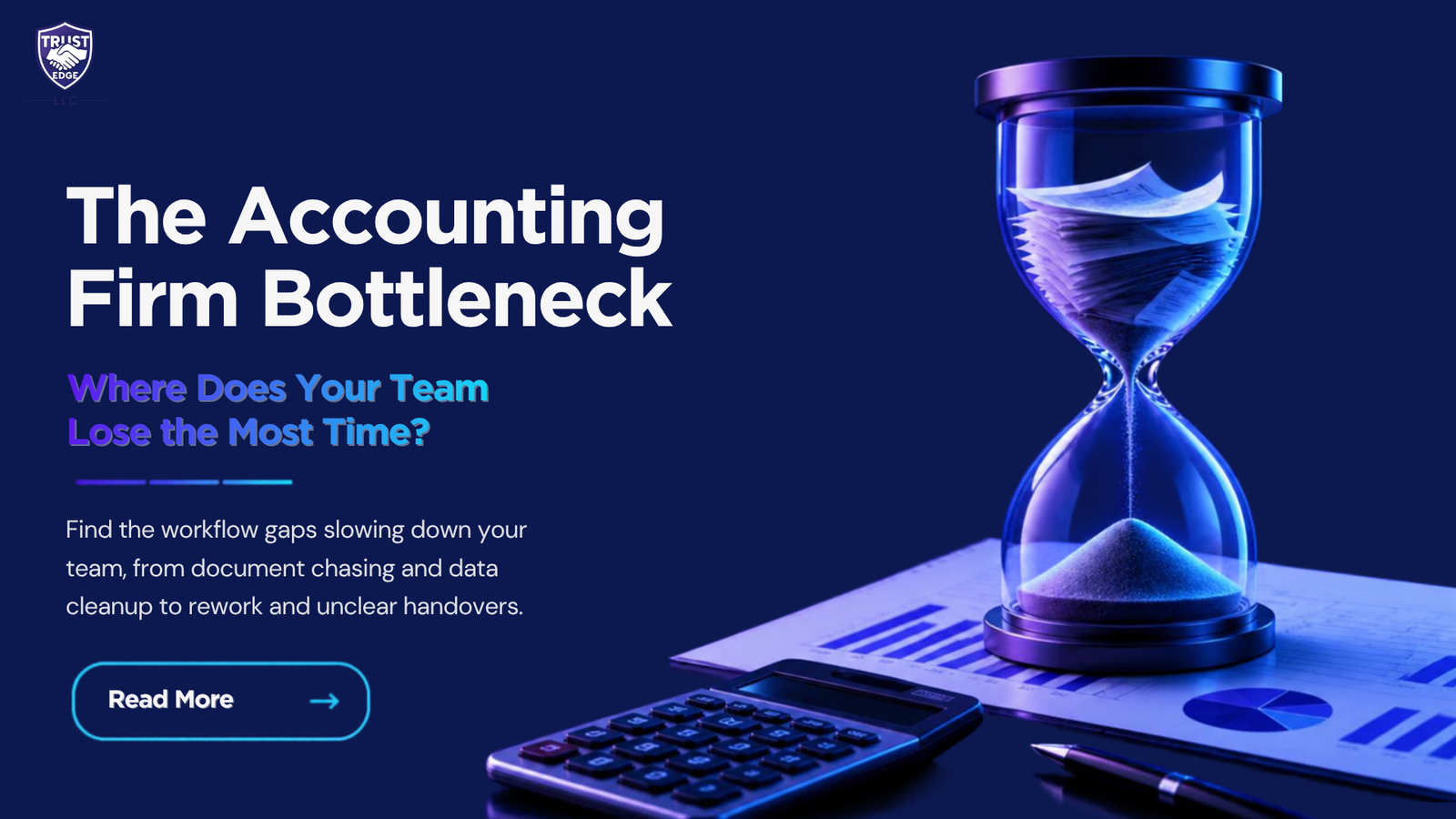
The Accounting Firm Bottleneck: Where Does Your Team Lose the Most Time?
The Accounting Firm Bottleneck: Where Does Your Team Lose the Most Time?
Your accounting team is busy. Client work is increasing, deadlines are getting tighter, and new files keep coming in.
But when work is still being delayed, the problem may not be the size of your team.
It may be the workflow.
For many accounting and audit firms, senior professionals spend too much time on work that does not require senior-level judgment: chasing documents, cleaning data, preparing schedules, organizing working papers, and fixing avoidable review comments.
The real question is:
Where is your team actually losing time?
Start With One Simple Question: Where Does the Time Go?
Before hiring another accountant or outsourcing work, look at how your team spends its time.
Track a few client files from start to finish and identify where work slows down.
You may find that the bottleneck is not the accounting itself. It could be:
- Waiting for client documents
- Manual data entry and cleanup
- Preparing working papers
- Reconciliations and supporting schedules
- Drafting financial statements
- Review comments and rework
- Repeated follow-ups between team members
Once you identify the bottleneck, you can decide what needs to change.
1. If Your Team Keeps Chasing Documents, Fix the Process First
Document collection can quietly consume hours every week.
Bank statements, invoices, contracts, payroll records, confirmations, and other supporting documents may arrive through different channels and at different times.
Instead of relying on repeated emails and messages, create a simple document workflow:
Requested → Received → Reviewed → Complete
Assign responsibility for each step and set clear deadlines.
A document tracker can also show which items are outstanding, who is following up, and which files are ready for preparation.
The goal is not simply to collect documents faster.
It is to prevent your accountants from repeatedly stopping their work to ask, “Where is this document?”
2. Separate Accounting Work From Data Preparation
Not every accounting task requires the same level of expertise.
Senior accountants should spend their time on areas that require professional judgment, technical accounting knowledge, client decisions, and review.
Routine execution can often be handled through a structured process.
For example:
Senior work:
Accounting treatment, complex reconciliations, technical issues, review, and client decisions.
Process-driven work:
Data organization, transaction processing, bank reconciliation cleanup, supporting schedules, and working paper preparation.
This does not mean lowering the quality of the work.
It means making sure the right level of work is handled by the right level of resource.
3. Find Out How Much Rework Your Team Is Doing
One of the biggest accounting firm bottlenecks is not always the first preparation.
It is the second, third, or fourth round of corrections.
A file may be prepared, reviewed, returned with comments, corrected, and reviewed again.
Over time, these small corrections become a major capacity problem.
Look at your recurring review comments.
Are the same issues appearing across different files?
For example:
- Missing supporting documents
- Incorrect references
- Incomplete schedules
- Inconsistent working paper formats
- Reconciliation differences
- Financial statement formatting issues
If the same comment appears repeatedly, it should become part of the preparation process.
A simple pre-review checklist can prevent many avoidable corrections before the file reaches the senior reviewer.
4. Standardize the Work That Gets Repeated
Different people often prepare the same type of work in different ways.
One accountant may use one working paper format, while another uses a completely different structure.
This makes review slower because the reviewer has to understand the format before reviewing the actual work.
Standardized templates can help with:
- Working papers
- Reconciliations
- Supporting schedules
- Financial statement preparation
- File organization
- Review checklists
The objective is not to make every client file identical.
It is to create a consistent starting point so the team does not have to rebuild the process every time.
5. Protect Senior Time
One useful exercise is to create a simple “Senior Time List.”
For one week, record the routine tasks performed by senior accountants and managers.
You may discover that valuable hours are being spent on:
- Following up on missing documents
- Cleaning spreadsheets
- Formatting working papers
- Preparing routine schedules
- Reviewing basic data issues
- Repeating the same corrections
Not every task needs to be removed from the senior team.
But every task should have a reason for being there.
The goal of accounting firm efficiency is not simply to make people work faster.
It is to make sure experienced professionals spend more time where their experience actually adds value.
6. Create a Clear Handover Between Preparation and Review
Another common bottleneck happens between the person preparing the file and the person reviewing it.
If the handover is unclear, the reviewer may spend time finding missing information instead of reviewing the accounting work.
Before a file reaches review, define what “ready for review” means.
For example:
- Required documents are available
- Reconciliations are completed
- Supporting schedules are attached
- References are checked
- Open issues are clearly identified
- Working papers follow the required format
A clear handover reduces unnecessary back-and-forth and helps the reviewer focus on higher-value issues.
7. Measure the Bottleneck Before You Outsource It
Outsourcing can increase capacity, but it works better when you know exactly what problem you are solving.
Before moving work outside the firm, measure a few simple numbers:
Turnaround time:
How long does it take to complete a typical file?
Rework:
How many times does the file return for corrections?
Senior time:
How many hours are experienced accountants spending on routine execution?
These numbers can help you determine whether the real issue is workload, workflow, or capacity.
They also help you identify which activities are suitable for accounting back-office support.
What Can Be Supported Remotely?
Once the bottleneck is clear, firms can separate core professional responsibilities from repeatable operational work.
Depending on the firm and engagement, accounting back-office support may include:
- Bookkeeping and transaction processing
- Bank and credit card reconciliations
- Supporting schedules
- Working paper preparation
- Audit file organization
- Financial statement preparation
- Routine data cleanup
- Document follow-ups
- Administrative accounting support
This allows the internal team to remain focused on technical accounting decisions, client relationships, review, and engagement management.
A Bigger Team Is Not Always the First Answer
When workloads increase, the first reaction is often to hire more people.
But if the workflow itself is inefficient, adding more people may simply increase the volume of work moving through the same bottlenecks.
Start by finding where time is being lost.
Then ask:
Can the process be improved?
Can the work be standardized?
Can routine tasks be delegated?
Can part of the workload be supported remotely?
The answer may not be a bigger team.
It may be a better accounting firm workflow.
The Bottom Line
Accounting firm growth is not only about adding more clients.
It is also about creating enough capacity to serve those clients without putting unnecessary pressure on senior professionals.
When you identify the bottleneck, reduce rework, improve handovers, and move routine work to the right resources, your existing team can often handle more work with greater consistency.
At TrustEdgeLLC, we provide remote accounting, bookkeeping, and audit back-office support for firms that need additional capacity without expanding their internal operations.
Follow TrustEdgeLLC for more practical insights on accounting operations, audit support, outsourcing, and scalable finance teams.