Arabic-English Financial Statement Translation for GCC Firms
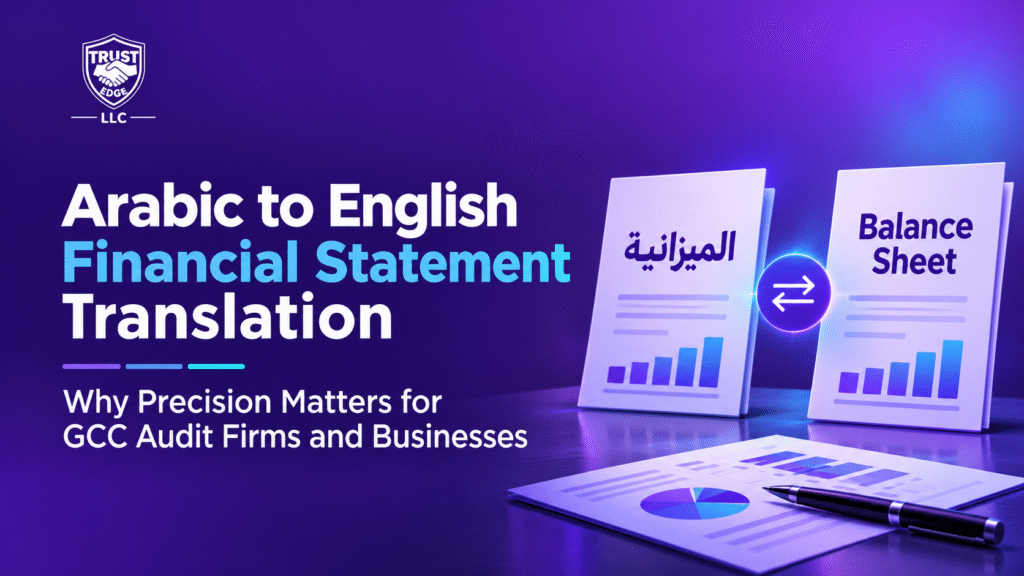
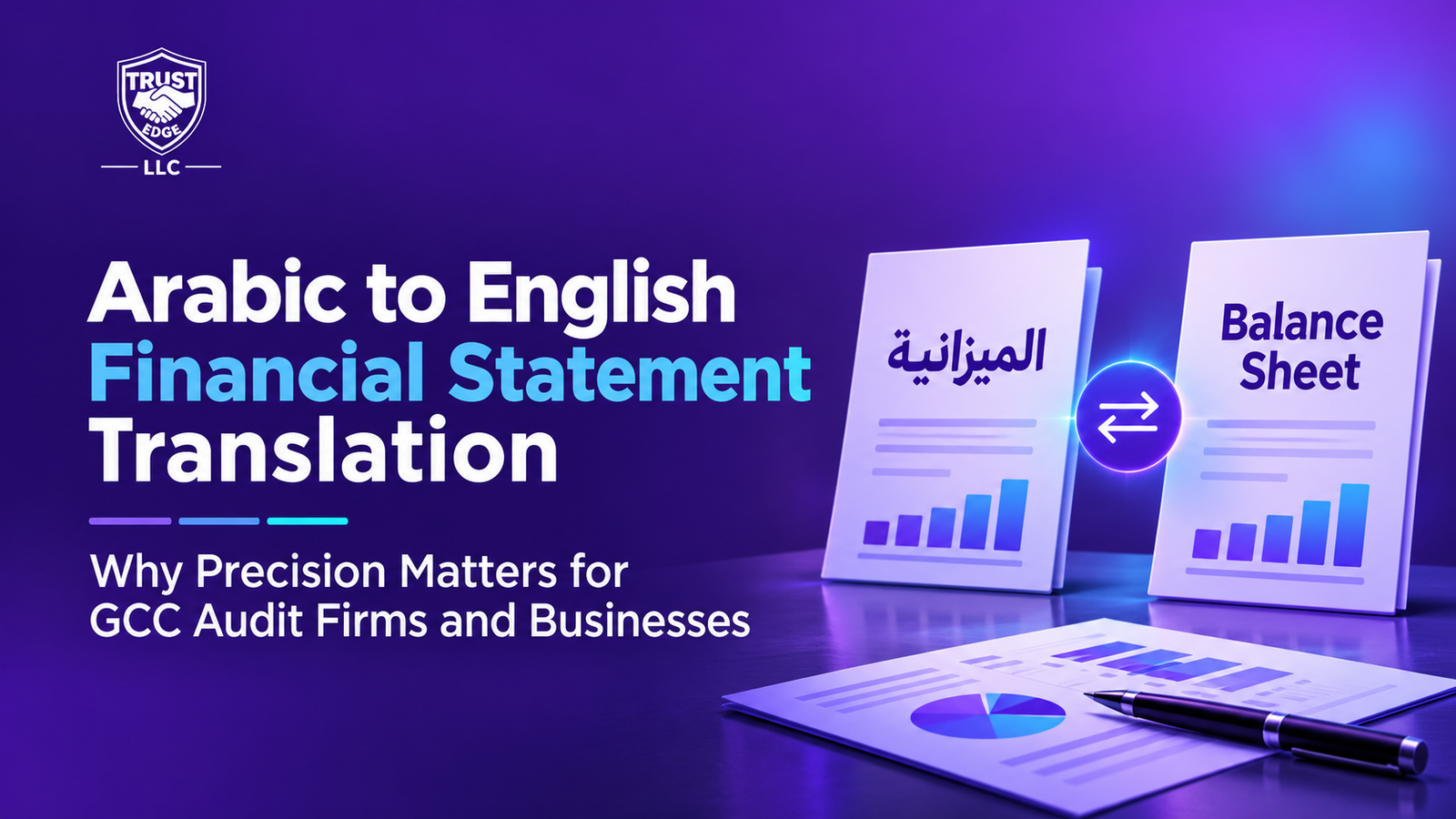
Arabic to English Financial Statement Translation: Why Precision Matters for GCC Audit Firms and Businesses
In the Gulf, financial statements live in two languages. The books and the official filings are often in Arabic, while banks, investors, parent companies and group auditors read in English. Most companies need both versions, and they need them to say exactly the same thing.
That is why translating financial statements is accounting work, not language work. One wrong term can change the meaning of a note, slow down a credit approval or start an unnecessary conversation with a regulator. In this article, we look at where the need for two languages comes from, where translation usually goes wrong, and how audit firms and finance teams can get it right.
Why Your Statements Need Two Languages
The need starts with local rules. In Saudi Arabia, every company prepares its annual financial statements under IFRS as endorsed by the Saudi Organization for Chartered and Professional Accountants (SOCPA) and deposits them on the Ministry of Commerce’s Qawaem platform within six months of year-end. Saudi law also requires accounting records to be kept in Arabic. Yet the same statements are often needed in English for a foreign parent, a regional bank or an international investor.
In the United Arab Emirates, the rules are more flexible but no less important. Under Cabinet Decision No. 74 of 2023 on the Executive Regulation of the Tax Procedures Law, tax returns and supporting records may be submitted to the Federal Tax Authority in Arabic or English. However, the FTA can still ask for an Arabic translation of any document submitted in English, within a period it sets. An English-only file can quickly become an urgent translation job in the middle of a tax review.
In both cases, the second version is not a courtesy copy. It is a document that someone will rely on, so it has to be as accurate as the first.
Where Translation Usually Goes Wrong
Most problems begin when year-end statements are handed to a general translator at the last minute. A good translator knows the language, but an audit file has its own logic, and three things tend to break.
The terms change meaning. Accounting words carry strict definitions in the official Arabic translation of IFRS Accounting Standards, published by the IFRS Foundation and translated by SOCPA. Confusing provisions (مخصصات) with reserves (احتياطيات), or mislabeling other comprehensive income (الدخل الشامل الآخر), tells an experienced auditor or credit officer straight away that no one with technical knowledge reviewed the file.
The statements stop matching each other. Every line in the statement of financial position, the statement of profit or loss and the cash flow statement must use the same wording and numbering as the notes behind it. Formatting matters just as much: digit style, brackets for negative figures, column alignment in right-to-left layouts and the order of comparative years all need to match across both versions. When translation happens outside an accounting workflow, cross-references break and comparatives shift.
The filing no longer fits. In Saudi Arabia, the Arabic wording reaches the data as well as the page. Qawaem receives financial statements in XBRL, a machine-readable reporting language, and the IFRS Foundation has published an Arabic translation of its IFRS Taxonomy. A line item labelled inconsistently in the statements is harder to tag correctly in the filing.
What It Costs When the Second Version Is Late
These mistakes rarely show up early. They surface at the end of the engagement, when time is shortest.
For audit partners and managers, it means senior staff checking Arabic and English drafts line by line late at night, instead of focusing on audit quality and risk. For business owners and finance managers, it means bank renewals, shareholder meetings and statutory submissions waiting on a document that should have been ready weeks ago.
In Saudi Arabia, the stakes are higher still. The Ministry of Commerce warns that companies failing to prepare financial statements under the endorsed standards, or to deposit them on Qawaem, can face a fine of up to SAR 500,000 under Article 262 of the Companies Law. A late or unfinished Arabic version is one of the easiest ways to miss that six-month deadline.
How to Get Bilingual Statements Right
The answer is not a faster translator. It is treating translation as part of preparing the financial statements, with each step closing one of the gaps above.
- Start from approved terminology. Build bilingual templates on the official Arabic translation of IFRS Accounting Standards, so the same term means the same thing in every file. Review them before 2027 reporting begins, because IFRS 18 introduces new income statement categories and subtotals, such as operating profit, that will need consistent Arabic labels.
- Translate inside the audit structure. The person translating should understand trial balances, lead schedules and disclosure checklists, so numbers, brackets and note references stay intact in both versions.
- Prepare both versions together. Drafting the second language alongside the first, not after it, removes the last-minute rush before the audit report is dated and the filing deadline arrives.
- Agree the governing language early. Decide up front which version prevails if the two ever differ, for both the statements and the signed audit report. A clear answer now saves arguments with banks, shareholders and regulators later.
Bilingual Statements Without the Last-Minute Rush, With TrustEdgeLLC
At TrustEdgeLLC, translation sits inside the accounting work, where it belongs. Our bilingual Arabic-English team, with Big 4 and Big 10 experience, prepares financial statements and translates them from Arabic to English or English to Arabic. Because we work inside IFRS and ISA every day, the financial meaning and the presentation stay the same in both languages.
- For GCC audit firms: We prepare, format and cross-check bilingual IFRS financial statements and notes, so your managers and partners review one consistent file and sign off faster.
- For GCC businesses: We make sure your management reports, statutory financial statements and supporting schedules say the same thing in Arabic and English, ready for your banks, auditors and regulators.
If your team spends busy season fixing translated statements, book a short call at trustedgellc.com and see how our back-office team can take that work off your desk.
Frequently Asked Questions
Which language prevails in bilingual financial statements? The one the company and its auditor agree as the governing language. State it clearly, so any difference between the Arabic and English versions has a clear answer.
Can the UAE FTA ask for an Arabic translation? Yes. Under Cabinet Decision No. 74 of 2023, documents may be submitted in English, but the FTA can request an Arabic translation of some or all of them within a period it sets.
How are financial statements filed in Saudi Arabia? Through the Ministry of Commerce’s Qawaem platform, in XBRL format, within six months of the financial year-end.
Sources
- Saudi Ministry of Commerce: Preparing and submitting financial statements through Qawaem
- Saudi Ministry of Commerce: Qawaem and XBRL filing
- IFRS Foundation: Use of IFRS Accounting Standards in Saudi Arabia
- Deloitte: Arabization requirements in KSA (Law of Commercial Books)
- BDO UAE: New Tax Procedures Executive Regulation (Cabinet Decision No. 74 of 2023)
- IFRS Foundation: Arabic translation of IFRS Accounting Standards
- IAS Plus: IFRS Foundation publishes the IFRS Taxonomy in Arabic